


The Supply-Chain Case for Biochar Carbon Removal
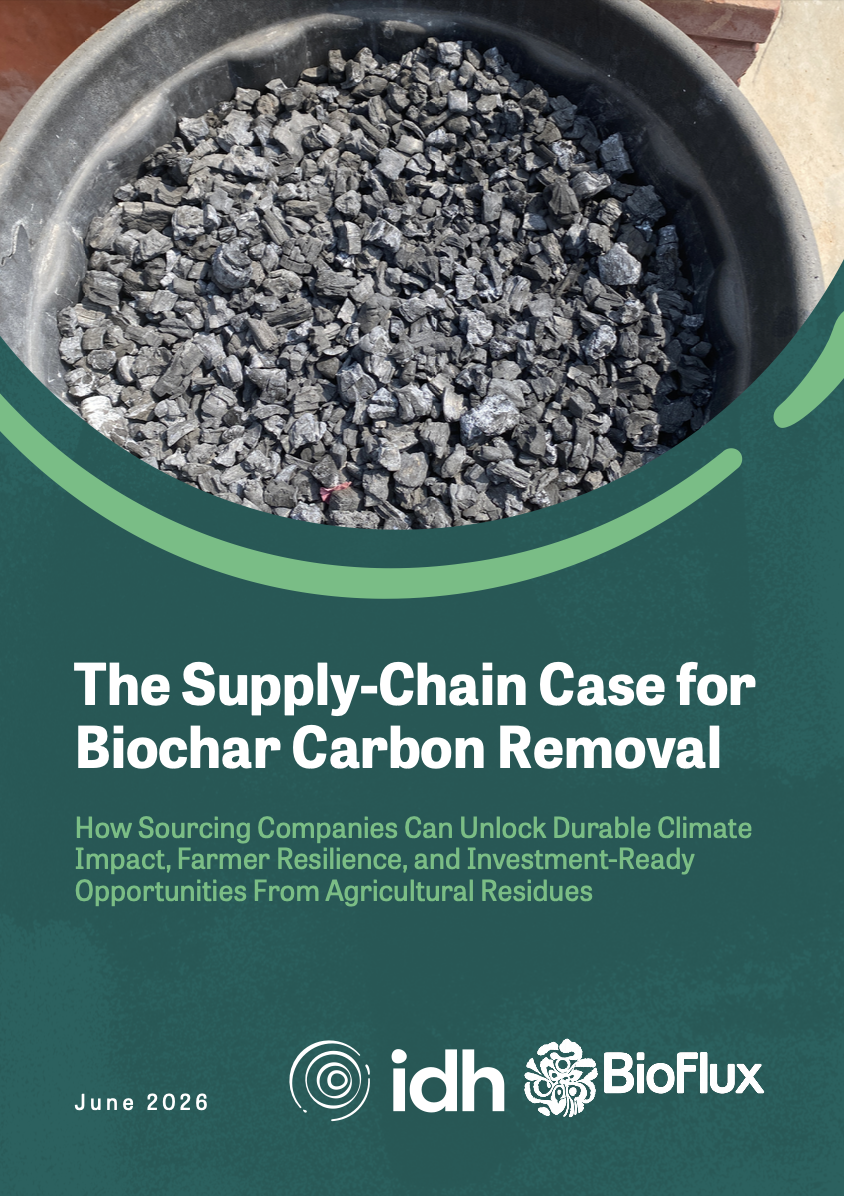
Why agricultural supply chains could become one of the most scalable deployment environments for durable carbon removal.
Companies sourcing coffee, cocoa, cotton and other agricultural commodities are under growing pressure to reduce emissions while strengthening the resilience of the supply chains on which they depend. Across these same value chains, growers, cooperatives, traders and processors are looking for ways to create more value from agricultural residues, while development finance institutions, NGO programme managers and other partners are seeking credible interventions they can finance, enable and scale.As biochar gains popularity as a sustainability strategy and moves from early interest to practical implementation, a key question emerges: how can it deliver credible, measurable impact at scale while creating value within the agricultural systems and the communities where it is deployed?Developed jointly by and , this white paper explores how biochar can help answer that question. It makes the case for biochar as one of the most deployment-ready durable carbon removal pathways for agricultural value chains, combining carbon removal, regenerative agriculture and supply-chain resilience through a single intervention. It also provides practical guidance for organisations looking to develop, finance or support biochar programmes, from identifying where the opportunity exists and selecting the right deployment model to understanding carbon-market quality, value and the conditions required to scale.
Key findings from the white paper:
1. Biochar is particularly well suited to agricultural value chains:
Agricultural residues can provide the feedstock for durable carbon removal, while the resulting biochar can be returned to farming systems. This creates the potential to connect carbon removal with residue management, soil improvement, farmer resilience and supply-chain value creation through a single intervention.
2. There is no single model for deployment:Biochar can be produced through distributed farmer- and cooperative-led systems or through larger industrial facilities located near processing hubs. The right model depends on residue availability, aggregation, capital requirements, operational capacity, farmer participation, MRV, and the type of impact the programme is designed to deliver.
3. Credible impact requires more than producing biocharThe quality and bankability of a biochar project depends on more than the production process itself. Credible projects answer questions related to where the feedstock comes from, what would have happened to it otherwise, how the technology is operated, what the full lifecycle emissions look like, how long the carbon remains stored and whether farmers share in the value created.
4. Carbon markets can help finance deployment, but quality and delivery increasingly determine value:Buyers are becoming more sophisticated, assessing projects based on permanence, additionality, MRV, delivery track record and independently verified co-benefits. Biochar is emerging as one of the most execution-ready durable CDR pathways, but projects still vary significantly in quality, risk and market value.
5. Scaling biochar is an ecosystem challenge:Successful programmes require coordination between those supplying residues, producing and applying biochar, financing deployment, verifying outcomes and purchasing carbon removal. For companies, DFIs, NGOs, cooperatives and other value-chain partners, the opportunity lies in building programmes that align these actors around a model designed to scale.
This report equips companies navigating the biochar carbon removal market with the tools to develop high-integrity programmes, from feedstock supply and technology selection through farmer engagement and carbon market positioning.
Agricultural residues can provide the feedstock for durable carbon removal, while the resulting biochar can be returned to farming systems. This creates the potential to connect carbon removal with residue management, soil improvement, farmer resilience and supply-chain value creation through a single intervention.
2. There is no single model for deployment:Biochar can be produced through distributed farmer- and cooperative-led systems or through larger industrial facilities located near processing hubs. The right model depends on residue availability, aggregation, capital requirements, operational capacity, farmer participation, MRV, and the type of impact the programme is designed to deliver.
3. Credible impact requires more than producing biocharThe quality and bankability of a biochar project depends on more than the production process itself. Credible projects answer questions related to where the feedstock comes from, what would have happened to it otherwise, how the technology is operated, what the full lifecycle emissions look like, how long the carbon remains stored and whether farmers share in the value created.
4. Carbon markets can help finance deployment, but quality and delivery increasingly determine value:Buyers are becoming more sophisticated, assessing projects based on permanence, additionality, MRV, delivery track record and independently verified co-benefits. Biochar is emerging as one of the most execution-ready durable CDR pathways, but projects still vary significantly in quality, risk and market value.
5. Scaling biochar is an ecosystem challenge:Successful programmes require coordination between those supplying residues, producing and applying biochar, financing deployment, verifying outcomes and purchasing carbon removal. For companies, DFIs, NGOs, cooperatives and other value-chain partners, the opportunity lies in building programmes that align these actors around a model designed to scale.
This report equips companies navigating the biochar carbon removal market with the tools to develop high-integrity programmes, from feedstock supply and technology selection through farmer engagement and carbon market positioning.